Your Brother’s Keeper: Making Sense of First Responder Grief
By Angela Valela August 25, 2026
When one falls, every officer who has ever worn that same uniform feels it land somewhere in their own chest. This reaction has a name: vicarious trauma.
There's a particular kind of dread that shows up before a shift lately. It’s a tightness in the chest that wasn't there a month ago. Maybe it's followed by guilt you can't quite explain, because you didn't know him. You never worked a shift with him, never sat across from him at a briefing. And yet the loss sits in you anyway.
This is first responder grief, and it doesn't require a personal connection to be real. It runs on something older and simpler: the uniform makes you brothers. When one falls, every officer who has ever worn that same uniform feels it land somewhere in their own chest. In every way that matters, you are your brother's keeper, whether you ever shook his hand or not.
A Hard Summer for Policing in Canada
It’s been a brutal stretch for policing in Canada. On June 9, OPP Constable Tarun Bali was killed near Hearst while attempting to stop a vehicle. Two days later, on June 11, Toronto Constable Marc Pinizzotto was shot and killed. Eleven days after that, on June 22, Montreal Constable Mohamed Benredouane was killed responding to a call about shots fired at a hotel in Côte-des-Neiges; the first SPVM officer killed on duty in 24 years.
Three officers. Under two weeks. If you're reading this, you already know the details better than any article can tell you. You lived through the briefings, the moments of silence, the flags at half-mast. This isn't background information for you. It's the backdrop you've been operating with, whether or not anyone at home has asked how you're doing with it.
Thousands Showed Up Because They Understood
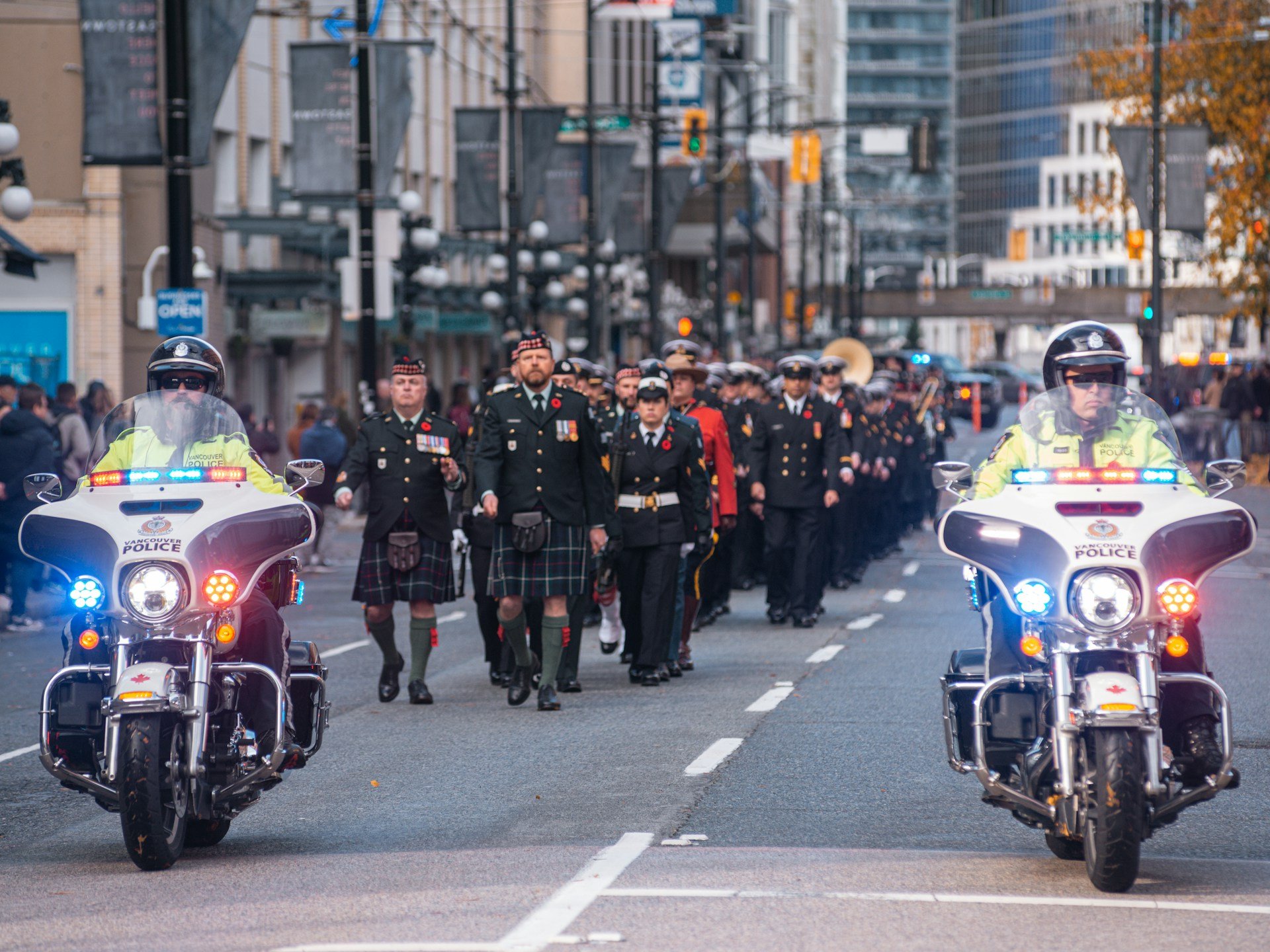
On July 7, close to 5,000 officers marched through downtown Montreal for Benredouane's funeral. They came from Halifax to West Vancouver, in dress uniform, alongside Indigenous peacekeepers and members of the Canadian Armed Forces. Bagpipes carried through the downtown core.
Almost none of those 5,000 officers had met him. They came anyway. That turnout says what you know: the bond doesn't need an introduction. It's built into the job itself. When thousands of people in matching uniforms travel across the country to grieve one man together, that's not protocol. That's proof of kinship.
The Ripple Effect in Line of Duty Death
This reaction has a name, even if it rarely gets discussed openly: vicarious trauma. It's what happens when repeated exposure to someone else's danger and loss, even from a distance, starts to register in your own nervous system as personal risk. You didn't experience the shooting. But your body, trained by years of shared risk and shared identity, reacts as though you did.
There's often a second layer underneath it: moral injury. Not the sharp edge of a single traumatic event, but a quieter ache that comes from watching the world treat your colleagues, and by extension you, as collateral damage. When an officer is killed and the reaction outside the profession feels muted compared to what you're carrying, that gap between what you feel and what you see reflected back can hurt almost as much as the loss itself.
This isn't generic sadness, and it isn't overreacting. It's a specific, physical, legitimate response to a profession where every line of duty death is, on some level, a death in the family.
When First Responder Grief Comes Home with You
Grief that doesn't get named tends to find another way out. Maybe it's a shorter fuse with your kids over something small. Maybe it's pulling away from your partner without meaning to or losing patience with people who have no idea what's sitting on your chest. Sleep gets thinner. You feel "off" in a way you can't pin down, and you might not connect it to a funeral you watched on the news two weeks ago.
This is common. It is not a character flaw, and it doesn't mean you're not cut out for the job.
Officers who never processed a loss because it “wasn't theirs to grieve” often carry grief the longest, precisely because they never gave themselves permission to feel it in the first place.
Signs and Symptoms of First Responder Mental Health Strain
Grief and compassion fatigue show up in the body as often as in the mind. A few patterns worth paying attention to:
physically, disrupted sleep
appetite changes, headaches, or stomach issues without another clear cause
a dread that doesn't lift
guilt that doesn't make logical sense
a feeling of numbness
irritability that feels disproportionate to what set it off
withdrawing from people you'd normally talk to
drinking or using more to unwind
avoiding news coverage and memorial events tied to the loss because they hit too close
None of these on their own means something is wrong: they're normal responses to an abnormal amount of loss. But when several show up together, or stick around longer than a few weeks, that's your body telling you this is bigger than something to shake off before next shift. These are hallmark signs of PTSD in first responders when left unaddressed, and they're worth taking seriously early.
When to Reach Out for First Responder Therapy
There's no single moment that makes seeking support “official.” But a few thresholds are worth trusting: if the symptoms above have lasted more than a few weeks, if they're intensifying rather than easing, or if they've started leaking into your work, your relationships, or your sleep in ways you can't manage alone.
Look at it this way: calling for backup when a situation is bigger than you is standard procedure, not a personal failing. First responder therapy works the same way.
Reaching out isn't waiting until you're in crisis: it's recognizing early that this particular call is bigger than what you're built to carry solo, and bringing in support before it has to be.
You Don't Have to Carry This Alone: NEST Can Help
NEST First Responder Therapy works exclusively with police, corrections, and other frontline professionals. That means you're not starting from zero, explaining what a line of duty death does to a department, or justifying why a funeral for someone you never met has stayed with you for weeks. Our therapists have deep, specific expertise in first responder mental health, including vicarious trauma, moral injury and the particular weight of ripple grief.
You don't have to wait until it's unbearable, and you don't have to carry it by yourself. If any of this sounds familiar, reach out to NEST to talk with a therapist who understands the job before you say a word about it.
Ready to Talk to Someone Who Gets It?
The NEST offers specialized First Responder Therapy for police officers, firefighters, paramedics, correctional officers, military and veterans, EMS dispatchers, nurses, doctors, and other frontline workers across the GTA, Hamilton, Peel Region, Burlington, Halton, Oakville and Niagara.
About the Author
Angela Valela is a Qualifying Registered Psychotherapist with a growing focus on trauma-informed care at NEST Psychotherapy. Angela has extensive experience working first responders, survivors of violence, and neurodivergent individuals. Throughout Angela’s career, she has worked in frontline and community roles with individuals experiencing grief, loss, and crisis, where she has developed resiliency, a strong understanding of the mind-body connection, and the impact of tragic circumstances on frontline emergency services workers.